What’s the Anion Gap?
The anion gap is a clinical calculation used to support review acid-base disorders and recognize patterns in serum chemistry. It compares the major measured cations and anions in blood, mainly sodium and chloride, along with bicarbonate and sometimes potassium. This makes it a practical tool for spotting an electrolyte imbalance that may not be obvious from a basic look at the lab panel.
In routine practice, the anion gap serves as a form of laboratory interpretation and clinical decision support. When the gap is elevated, it often indicates the presence of unmeasured anions from an underlying metabolic derangement. When the gap is low, it may suggest albumin loss, lab variation, or other less common issues. Because it is a window into the body’s acid-base state, the anion gap is a valuable part of a broader diagnostic framework.
The concept is especially important in metabolic acidosis evaluation, where it helps separate high anion gap metabolic acidosis from normal anion gap metabolic acidosis. That distinction directs the next steps in patient assessment and can focus the search for causes quickly.
How to Determine the Anion Gap
The standard anion gap formula is:
Anion gap = serum sodium − (serum chloride + serum bicarbonate)
Some clinicians add potassium in the equation, but the typical version leaves it out because potassium contributes relatively little to the final value. When included, the formula becomes:
Anion gap = (serum sodium + potassium) − (serum chloride + serum bicarbonate)
To use the calculation correctly, you need values from a basic metabolic panel or an equivalent electrolyte panel. The key inputs are serum sodium, serum chloride, and serum bicarbonate. These values are part of routine serum chemistry testing and are commonly available in acute and outpatient settings.
A simple example helps show the math:
- Sodium: 140 Chloride: 102 Bicarbonate: 24
The anion gap would be 140 − (102 + 24) = 14.
This medical calculation is not just about arithmetic. The result should be read in context, especially when evaluating metabolic acidosis or other acid-base abnormalities. Small differences in lab methods and here normal variation can affect the final number, which is why the reference range matters.
How to Work with an Anion Gap Calculator
An Anion Gap Calculator can accelerate the work of laboratory interpretation by transforming raw laboratory values into an immediate result. This is useful in contexts where fast clinical decision support helps determine whether a patient needs further evaluation for an acid-base problem.
The core calculation steps are easy:
- Input the serum sodium value. Input the serum chloride value. Provide the serum bicarbonate value. You can also add potassium if the calculator allows it. Compare the result against the expected reference range.
Many calculators also include albumin correction, which is useful when serum proteins are out of range. Since albumin is a major unmeasured anion, low levels can make the measured gap look falsely normal or low. A calculator that adjusts for this can provide a more accurate corrected value.
Use the result as a diagnostic aid, not as a standalone diagnosis. The anion gap is one part of a full acid-base analysis that may also include blood gas data, clinical context, and additional labs. In that sense, the calculator supports both quick screening and deeper metabolic acidosis evaluation.
Standard Anion Gap vs Elevated Anion Gap Acidosis
A key use of the anion gap is separating normal anion gap metabolic acidosis from high anion gap metabolic acidosis. They are both forms of metabolic acidosis, but they indicate different mechanisms and different causes.
In normal anion gap metabolic acidosis, bicarbonate is depleted or chloride rises to compensate for it, so the gap stays in the anticipated reference range. This pattern commonly indicates a hyperchloremic process rather than an accumulation of acids. It is still an important acid-base disorder and should not be dismissed simply because the gap is normal.
In high anion gap metabolic acidosis, excess acid or acid precursors contribute unmeasured anions to the blood. That raises the gap and signals a different class of pathology. This is a key clue in acid-base disorders because it often alters the differential diagnosis substantially.
The practical value of this distinction is that it focuses the interpretation guide. A patient with anion gap elevation needs evaluation for causes that produce acid accumulation, while a patient with a normal gap may need assessment for bicarbonate loss, renal tubular issues, or other non-gap processes. This approach improves the overall diagnostic framework.
Typical Causes of Elevated Anion Gap
Several classic conditions cause anion gap elevation. The most common include lactic acidosis, ketoacidosis, renal failure, and exposure to toxic alcohols. Each leads to accumulation of acids or acid byproducts that elevate the number of unmeasured anions.
Lactic acidosis occurs when lactate builds up due to tissue hypoperfusion, shock, severe infection, seizures, or other states of impaired oxygen delivery. It often causes high-gap acidosis and often needs urgent attention.
Ketoacidosis may occur in diabetes, prolonged fasting, alcohol use, or starvation states. Ketone bodies act as acids and elevate the gap, so this diagnosis is often considered in metabolic acidosis evaluation when glucose or nutritional history suggests it.
Renal failure can also lead to a rising gap because the kidneys cannot excrete acid effectively, allowing organic acids to accumulate. Over time, this becomes a clear marker of worsening metabolic derangement.
Toxic alcohols, such as methanol or ethylene glycol, are dangerous causes of high-gap acidosis. Their metabolism produces acids that markedly raise the anion gap and require rapid recognition. In these cases, the gap may be an early clue even before all confirmatory testing is available.
Other causes can exist, but these are the high-yield diagnoses that most often appear in an interpretation guide. The goal is not just to identify the gap but to connect it to the likely source of the acid load.
Correcting for Albumin and Its Importance
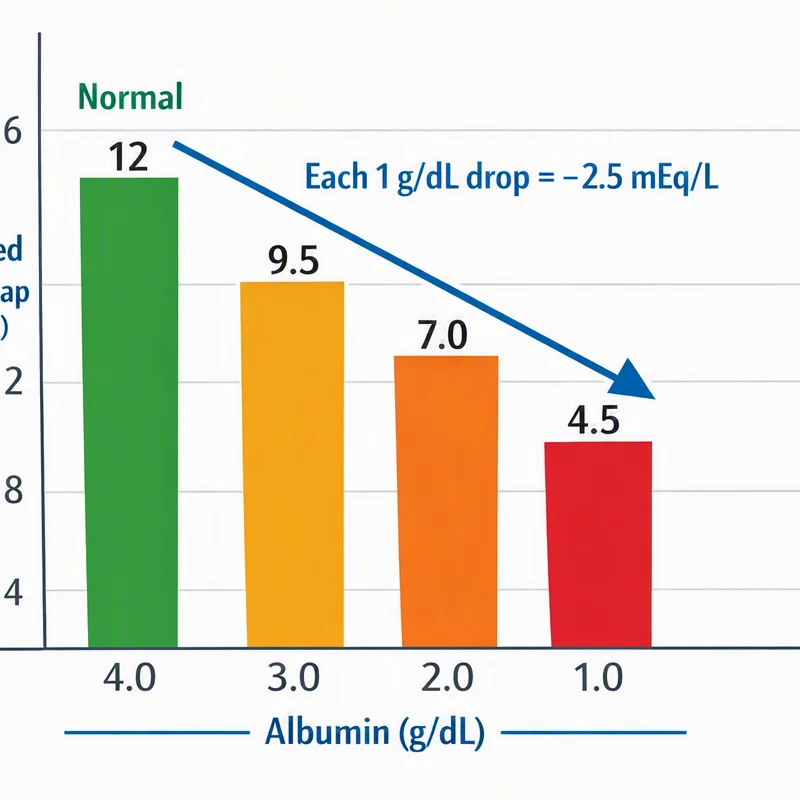
Hypoalbuminemia can hide an abnormal gap because albumin is one of the main unmeasured anions in the bloodstream. When albumin levels is reduced, the measured anion gap may look misleadingly normal even when acid is present. That is why albumin correction is such an key step in result interpretation.
A corrected anion gap modifies the measured number to reflect the effect of low albumin. This is particularly important in ill patients, where albumin often falls because of inflammation, malnutrition, liver disease, or fluid shifts. Without the correction, an underlying elevated-gap disorder may be missed.
A commonly used albumin-adjustment formula adds a specific value to the measured gap for each reduction in albumin below normal. Different institutions may use slightly different versions, but the principle is the same: when albumin falls, the expected gap falls the expected gap. Because of this, the normal range may need to be interpreted with more caution when albumin is abnormal.
Albumin correction improves the usefulness of the Anion Gap Calculator as a diagnostic aid. It helps identify hidden gap reduction or a missed elevation and makes the result more accurate for patient assessment. In practice, this means the raw number is only the starting point; the corrected result often tells the real story.
How the Anion Gap Works Within Acid-Base Analysis
The anion gap is just one part of acid-base analysis. A thorough workup often includes an arterial blood gas, which supplies pH and measured bicarbonate levels, together with information about ventilation. Together, these data show whether the primary problem is metabolic, respiratory, or mixed.
When the blood gas shows acidemia and the anion gap is elevated, the clinician can with greater confidence pursue causes of high anion gap metabolic acidosis. If the pH is low but the gap is normal, the interpretation shifts toward normal anion gap metabolic acidosis or another non-gap process.
Respiratory compensation also matters. In metabolic acidosis, the lungs often lower carbon dioxide to counteract the acid load. If compensation is adequate, the patient may be partially stabilized. If it is inadequate or excessive, another disorder may be present. That is why the anion gap should be used with the arterial blood gas rather than in isolation.
This broader diagnostic framework is essential in complex cases. A patient may have a metabolic acid-base disorder, but the blood gas and anion gap together reveal the anion gap in chronic kidney disease true pattern. In this setting, the gap becomes a practical guide to the next step in the interpretation guide, not the final answer.
Common Analysis Errors
Several problems can result in inaccurate judgments when interpreting the anion gap. One of the most typical is lab error. Specimen contamination, handling issues, or incorrect readings can distort sodium, chloride, or bicarbonate values and yield a misleading result. If the number does not fit the clinical picture, repeat testing may be necessary.
Another concern is focusing only on the total gap and missing the role of unmeasured anions or serum protein changes. Because albumin is such a major contributor, failing to correct for hypoalbuminemia can obscure an important elevation. Likewise, assuming a normal result excludes serious disease can be a mistake.
The delta gap is useful when evaluating mixed processes. It compares the change in the anion gap to the change in bicarbonate and can suggest whether another acid-base disorder is present. If the findings do not align, a mixed acid-base disorder may be hiding underneath the apparent primary problem.
This is important because a patient can have more than one process at the same time. For example, a high anion gap metabolic acidosis may coexist with metabolic alkalosis or a concurrent respiratory issue. A careful look at the full serum chemistry, blood gas, and clinical context is the best way to avoid missing these overlapping abnormalities.
Common Questions
How large is a normal anion gap range?
The anion gap normal range depends on the lab method and whether potassium is included in the calculation. In many settings, the typical range is roughly in the single digits to low teens, but the exact reference range can vary by institution. Always interpret the result using the range reported by the laboratory and consider whether albumin correction is needed.
How do you determine the anion gap from lab values?
Use the anion gap formula: serum sodium minus the sum of serum chloride and serum bicarbonate. Some versions also include potassium. The values usually come from a basic metabolic panel. An Anion Gap Calculator can perform the clinical calculation quickly and reduce arithmetic errors during laboratory interpretation.
What makes low albumin affect the anion gap?
Decreased albumin lowers the amount of negatively charged blood proteins in blood, which can lower the measured gap. This means a patient with a real acid-base problem may appear to have a normal result unless albumin correction is applied. A albumin-corrected anion gap gives a more precise picture of the underlying disturbance.
Why is there a high anion gap?
Frequent elevated anion gap causes include lactic acidosis, ketotic acidosis, kidney failure, and poisonous alcohols. These conditions produce or retain acids that increase unmeasured anions in the blood. When the gap is elevated, the result should be interpreted alongside the arterial blood gas, patient history, and other laboratory findings.
In what situations should an anion gap be repeated or corrected?
Remeasure or correct the anion gap when the result does not match the clinical picture, when testing error is possible, or when albumin is low. It should also be checked again if the patient’s condition changes, if new metabolic acid buildup is suspected, or if a combined acid-base disorder is being evaluated. In many cases, repeating the serum chemistry and applying albumin adjustment increases diagnostic accuracy.